Analysis: Responding to Questions and Comments
Written on Sunday, March 23, 2014 by Unknown

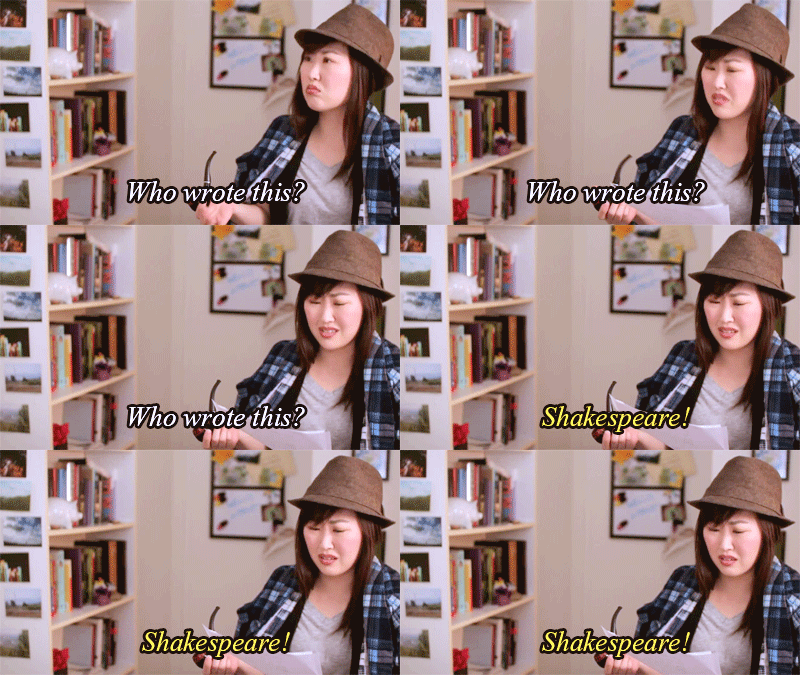
This is usually how I feel when my advisor and I talk about my thesis. But that's okay. It is called a "rhetoric major" for a reason. Insert some kind of joke about rhetorical questions here. Insert horribly cheesy laugh track after said joke.
In response to a previous post my advisor asked the following questions:
Do kernels and satellites rely on the knowledge of the viewer? Can an
analysis be nuanced enough to account for both the "novice viewer" and
"fully immersed"?
I think I addressed this (very very briefly) in my video when I talk about some of the problems with the Scene Function Model. The developers of that model tested it on students. When they talked to them about which scenes they
thought were kernels and satellites, the new viewers found certain
scenes to be kernels while returning viewers or fans did not. This was
because the fans had previous knowledge about the characters/plot. The new viewers lacked this knowledge and therefore thought that everything was much
more important. So I think that the answer to this is two-fold. Yes,
kernels and satellites can rely on the knowledge of the viewer, but they
don't always have to.
Let's say Lizzie rants about some event that
already took place and new viewer just jumped in on that episode with no
other knowledge about the show. They might consider the rant to be important (and a kernel) because
it summarizes previous pertinent information. But a returning viewer would call
this repetitive information (and thus a satellite). So this case
would rely on prior knowledge. But what if the viewer jumped in during
the event? Then it wouldn't matter if they knew the background of the
characters, because clearly this plot development was important and
changed the course of the episode/series. This might be a bad example,
but I hope the point is at least somewhat clear. And I don't know if an
analysis can be nuanced enough, because I am an informed viewer already
and am thus already biased. Perhaps if someone else were doing this
about something I haven't seen I could answer this question more
thoroughly.
I also think this question was in response to the book comparison problem, which is even more complex. When talking about kernels and satellites, should we consider the book? For this thesis, I think I am going to say no. The show needs to stand on it's own because I am analyzing transmedia, not adaptation theory or something like that. It is also a modernization, so character motivations are different, events have different impacts, and there are more opinions provided than in the novel. Basically, it is different enough that even though readers like to compare and contrast and will definitely experience the show in their own way, calling an event a kernel or a satellite based on how it played out in the book would be incorrect. Pride and Prejudice takes place over 200 years ago in England during the time of the landed gentry. The Lizzie Bennet Diaries takes place in 21st century United States and uses a hell of a lot more technology. Expectations are not the same. Motivations are not the same. Actions have different repercussions. Central themes (like marriage/relationships) play out much differently. So I just cant say that X scene is a kernel because it was a kernel in the novel. It wouldn't make sense to do that every time. Yes, sometimes the book and show are very close and kernels/satellites are the same, but this is a parallel. Which, you know, tends to happen in adaptations. It's not an unwritten commandment that everything must be taken exactly the same way. Sorry book lovers. I am a Janeite too, but I just can't analyze the show that way.
Hopefully this all made sense. And professor, let me know if I didn't fully answer your questions. I'd love to hear your response.
I'm pretty stoked that I actually came to a conclusion about the book issue. Wohoo!
Anything else? Anyone else?

-Danny